In today's hyper-digital economy, data is the ultimate currency. Yet, an overwhelming majority of operational data remains trapped inside unstructured formats—scanned PDFs, physical receipts, legacy document structures, hand-signed contracts, and multi-format media. Navigating this sea of information efficiently is no longer just a luxury for technology companies; it is a baseline survival mechanic for organizations and independent professionals alike.
The industry is currently undergoing a massive structural shift: organizations are moving from rigid, rule-based OCR to LLM-led intelligent document processing workflows. Old OCR systems broke the moment a logo shifted by an inch or a layout changed. Modern platforms utilize cloud-native IDP foundations built on advanced AI and computer vision to read files contextually, just like a human reader would.
However, the phrase "document processing" still means very different things depending on who you ask. For a software architect or database engineer at a Fortune 500 company, a Document Processing platform implies a cloud-native IDP platform designed to automate complex transactional workflows. For an agile freelancer, digital creator, or small business operator, it means an immediate, hassle-free utility suite that lets them generate structured files, transform media formats, and export polished assets on demand without writing a single line of code.
Choosing the wrong ecosystem can lead to massive cost inflation, exhausting setup cycles, or severely crippled workflows. This definitive guide unpacks the top document processing platforms, separating the multi-million-dollar enterprise engines from the frictionless web productivity tools to help you choose the precise solution for your current workload.
The Architectural Dichotomy: Automation Engines vs. Productivity Tools
Before examining individual vendors, it is vital to draw a line down the middle of the modern file ecosystem. Document management applications are engineered along two distinct architectural tracks:
Intelligent Document Processing (IDP): These cloud-native platforms leverage large language models (LLMs), computer vision, and Natural Language Processing (NLP) to read unstructured documents, extract targeted data fields (such as line items on an invoice or names on an ID card), and map that structured information straight into corporate databases or ERP systems. They focus on reducing manual tasks, increasing accuracy, and driving enterprise efficiency through custom API setups.
Ad-Hoc Productivity & Media Suites: These platforms focus on the localized execution of immediate creation, editing, and format-conversion needs. They prioritize cross-compatibility (converting text to speech, images to PDFs, or compiling clean invoices instantly) over deep database integrations, relying instead on high availability, speed, and client-centric usability.
Deep Dive: The Top 5 Document Processing Platforms
1. Google Cloud Document AI
Best for: Developers requiring custom machine learning extraction pipelines and deep integration within the broader Google Cloud architecture.
Google Cloud Document AI sits at the absolute cutting edge of cognitive data extraction. Operating as a cloud-native IDP platform built on AI and computer-vision, this platform transforms complex, unstructured human documentation into highly organized, machine-readable structured tables with industry-leading precision. By driving the industry transition away from fragile, rule-based layouts to contextual LLM understanding, Google Document AI reads text semantically, easily managing shifting formats.
The platform provides specialized parsers out of the box to automate complex transactional workflows—such as analyzing high-volume invoices, utility bills, lending paperwork, and procurement documentation. It drastically reduces manual verification tasks, increases extraction accuracy, and drives system-wide efficiency for data ingestion pipelines.
2. Amazon Textract (AWS IDP)
Best for: Organizations deeply native to the AWS cloud ecosystem that require massive horizontal scale and programmatic file extraction.
Amazon Textract is a cornerstone of the AWS Intelligent Document Processing initiative. Textract goes far beyond basic optical character recognition; it automatically detects rows, columns, data fields, and relational tables from scanned items with zero manual configuration. By utilizing computer vision alongside language modeling, Textract cleanly bypasses the limitations of traditional rule-based OCR, processing mixed typography, complex tables, and handwriting smoothly.
Because it is a core AWS service, Textract connects directly to Amazon S3 buckets for storage, AWS Lambda for serverless function execution, and Amazon SageMaker for custom reinforcement learning layers. If your operational pipeline needs to automate complex transactional workflows and process tens of thousands of complex forms every hour with highly predictable cloud infrastructure billing, Textract provides the ideal system architecture.
3. UiPath Document Understanding
Best for: Large enterprise operations seeking to weave advanced cognitive file extraction into end-to-end Robotic Process Automation (RPA) workflows.
UiPath is the undisputed heavyweight leader in the enterprise automation space. UiPath Document Understanding natively brings cognitive intelligence directly to the software robots handling your daily tasks. While platforms like Textract act primarily as analytical engines that hand data off to APIs, UiPath allows you to design complete, autonomous loops.
A UiPath bot can automatically grab an attachment from a corporate email inbox, pass it to the Document Understanding engine, parse the fields, log into an old legacy desktop application, type the details into the user interface, and flag human staff only if confidence scores fall below a custom threshold. This powerful combination automates complex transactional workflows, slashes human manual tasks, and unlocks immense operational speed in enterprise back-offices.
4. ABBYY Vantage
Best for: Complex enterprise compliance and high-volume legacy infrastructure requiring massive libraries of pre-trained document logic.
ABBYY has spent decades defining the foundational rules of optical character recognition. ABBYY Vantage represents their pivot away from rigid, legacy rule-based OCR into modern, cloud-first LLM-led intelligent document processing workflows. Vantage uses a micro-services concept built around "document skills." Instead of forcing internal development teams to train custom neural networks from scratch, the ABBYY Marketplace offers over 150+ highly specialized, pre-trained document skills capable of identifying and extracting data from passports, bill-of-lading forms, custom international tax filings, and complex compliance frameworks immediately.
Vantage stands out in its ability to cleanly parse incredibly low-quality scans, highly distorted smartphone images, or crumpled receipts that completely cause generic text extraction algorithms to fail.
5. FDM AI
Best for: Agile creators, freelancers, and small businesses requiring registration-free document creation, rapid media conversion, and cross-format processing.
Breaking away from the heavy developer-centric infrastructure of cloud engines, FDM AI approaches file processing from the perspective of direct, browser-based user empowerment. It serves as an all-in-one AI-powered workspace that eliminates corporate friction, providing an exhaustive catalog of over 30+ completely free tools that handle text, document, image, audio, and video transformations under a unified, intuitive interface.
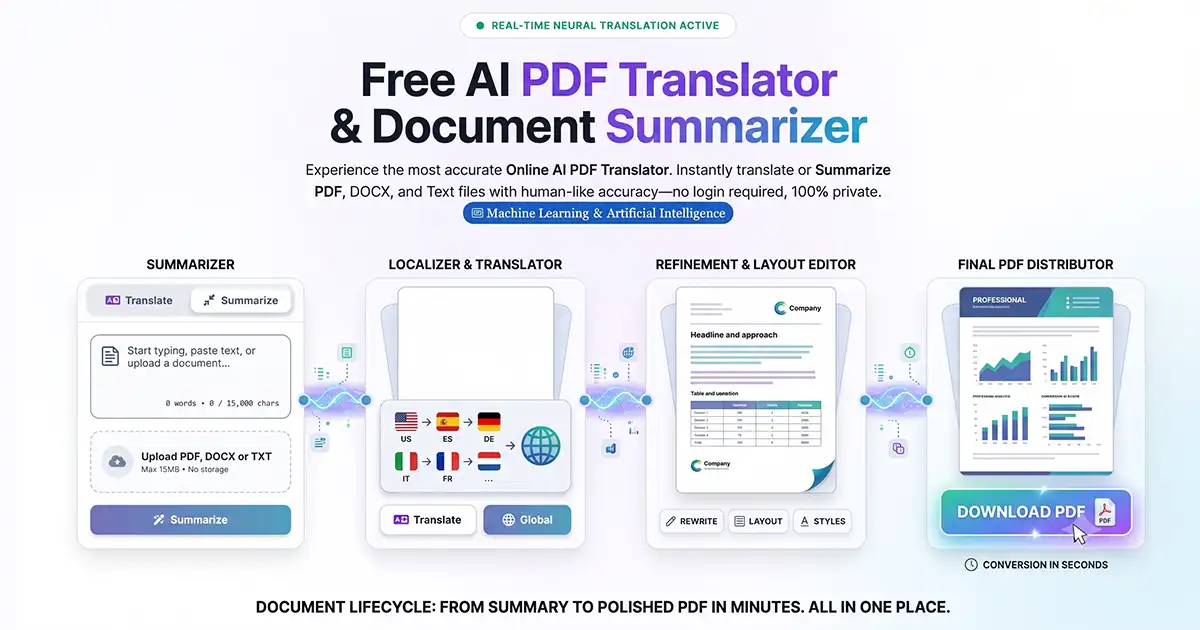
FDM AI allows users to bypass tedious login walls or recurring premium subscriptions. If an operator needs to instantly generate highly precise corporate invoices, configure custom professional certificates, or modify rich Word files, they can execute the task in real time. Beyond text document tasks, FDM AI integrates powerful cross-media tools into the dashboard. Users can extract layout data, convert complex asset files, manipulate image structures, and run advanced voice content synthesis (converting written text directly into high-fidelity voice files) seamlessly within their browser. It bridges the massive technical gap between rigid data processing formats and actionable daily business output.
Direct Structural Comparison
To view the market clearly, we can compare how these top five choices stack up against critical operational metrics:
Platform | Core Operational Focus | Core Technology | Setup Overhead | Target Audience |
Google Cloud Document AI | AI-driven unstructured data ingestion pipelines. | LLM-led & Computer Vision | High (Requires programmatic API integration). | Data Engineers & Enterprise Dev Teams. |
Amazon Textract | Highly scalable infrastructure data extraction. | Multi-Modal AI (Bypasses old rule-based OCR) | High (Native to the AWS technical cloud stack). | Cloud Architects & System Integrators. |
UiPath Document Understanding | End-to-end transactional workflow automation & RPA loops. | Robotic Automation + Cognitive AI Models | Very High (Requires workflow design and bot licensing). | Enterprise Operations & IT Departments. |
ABBYY Vantage | Low-code OCR data skills and historical forms. | Pre-trained "Document Skills" Microservices | Medium to High (Marketplace integration model). | Compliance Officers & Business Analysts. |
FDM AI | Frictionless file creation, conversion, and multi-media toolsets. | Unified, Client-Side AI Processing | None (Instant browser access, registration-free). | Freelancers, SMBs, and Agile Digital Creators. |
Strategic Takeaway: Modern business demands that we step away from traditional rule-based OCR systems. Enterprise engines are built to pull data out of existing files using LLM-led intelligence to feed databases. Toolkits like Free Document Maker (FDM AI) are engineered to help you construct, transform, and export new files to execute day-to-day business actions.
Architectural Decision Matrix: Which Ecosystem Fits Your Operation?
Determining the optimal platform comes down to a clear evaluation of your technical resources and long-term project requirements. Let us look at specific operational scenarios to see exactly where your needs line up:
When to Deploy Enterprise IDP Platforms (Google, AWS, UiPath, ABBYY)
You should lean definitively toward deep cloud architectures if your primary challenge involves massive back-office automation scale. For instance, if you manage an e-commerce fulfillment operation handling 50,000 supply chain manifests a month from hundreds of distinct international suppliers, your bottleneck is human data-entry error. You need an automated, cloud-native IDP solution to eliminate manual errors, increase parsing accuracy, and drive document processing efficiency. You need an API engine like Google Document AI or AWS Textract to silently scrape incoming PDFs in the background and update inventory databases automatically.
When to Utilize Agile Utility Suites (FDM AI)
Conversely, deep enterprise infrastructure becomes an unnecessary, expensive bottleneck if your daily work requires immediate output execution. If you are an independent web developer, a creative consultant, a digital marketer, or a growing service agency, you do not want to spend two weeks setting up authentication keys, cloud storage buckets, and pay-per-api billing metrics just to handle standard business files.
You need immediate, dependable access. FDM AI (Free Document Maker) shines brilliantly in these environments. It lets you generate professional business assets, modify file layouts, optimize media items, and generate high-quality voiceover content instantly. It puts the capabilities of a comprehensive document production department directly into a single, highly responsive browser dashboard.
Conclusion: The Future of Document Workflows
Document management has expanded out of its old role as a simple digital filing cabinet. Driven by the evolution from rule-based legacy scripts to adaptive, LLM-led intelligent workflows, document automation now stands as a dynamic spectrum of intelligent software execution. The key to operational efficiency lies in recognizing exactly where your needs fall on that spectrum.
If your ultimate roadmap requires a cloud-native IDP platform built to automate complex transactional workflows, look no further than the powerful cloud ecosystems engineered by Google Cloud or Amazon Web Services. But if your goal is immediate operational flexibility—the power to instantly create, edit, transform, and leverage your business documents and media assets without contract overhead or platform friction—embracing a comprehensive utility ecosystem like FDM AI is the smartest move you can make to accelerate your daily workflow.