Quick Summary: Explore how AI-powered document generation and browser-native technology are changing document workflows in 2026, making document creation faster, simpler, and more accessible.
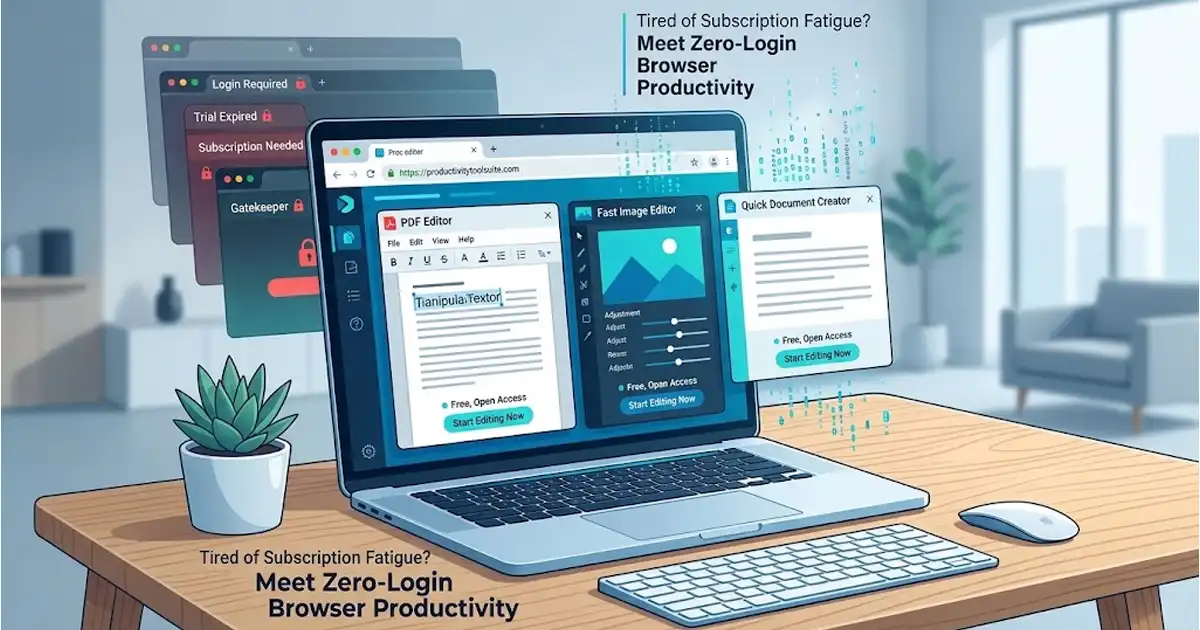
AI document creation has completely revolutionized how professionals, students, and creators handle daily paperwork. For decades, creating, editing, and converting professional documents felt like navigating a digital obstacle course. Users were forced to download heavy desktop software, create mandatory accounts, and accept recurring monthly subscriptions just to perform basic file formatting. Worse yet, everyday tasks required uploading sensitive, private files to remote cloud servers.
As we navigate through 2026, the digital landscape has shifted dramatically. The combination of generative artificial intelligence and advanced browser-native document tools is redefining digital workflows. Instead of relying on bloated legacy applications, modern users are turning to lightweight, instant, and privacy-focused web utilities.
1. The Breaking Point: Subscription Fatigue and Legacy Bloat
The primary driver behind the modern productivity shift is widespread software fatigue. Traditional document suites have become overloaded with unnecessary features, hidden paywalls, and aggressive upselling. When a user simply needs to convert a quick draft or edit a file on the fly, forcing them through a multi-step registration process creates unnecessary friction.
Furthermore, traditional cloud-dependent software introduces security vulnerabilities. Every time a business document or personal essay is sent to a third-party server for processing, the risk of data exposure increases. Modern workflows demand an alternative: tools that respect user time, lower financial barriers, and eliminate unnecessary cloud storage dependencies.
2. AI vs. Traditional Document Creation: Understanding the Shift
It is essential to distinguish between traditional file conversion and true AI document creation.
Traditional Conversion: Legacy tools operate on rigid rules. A standard text-to-PDF utility simply takes pre-formatted text and wraps it into a static layout without understanding context, tone, or structure.
AI-Driven Generation: Modern AI systems actively assist in structuring, drafting, and optimizing content. Using tools like an AI Document Writer, creators can input raw prompts, outlines, or bullet points, and the system synthesizes them into publication-ready layouts instantly.
When combined with an advanced Free Text to PDF Converter, this technology bridges the gap between raw thought and formatted output in seconds.
3. The Engineering Reality: Browser-Native Technology and Client-Side Processing
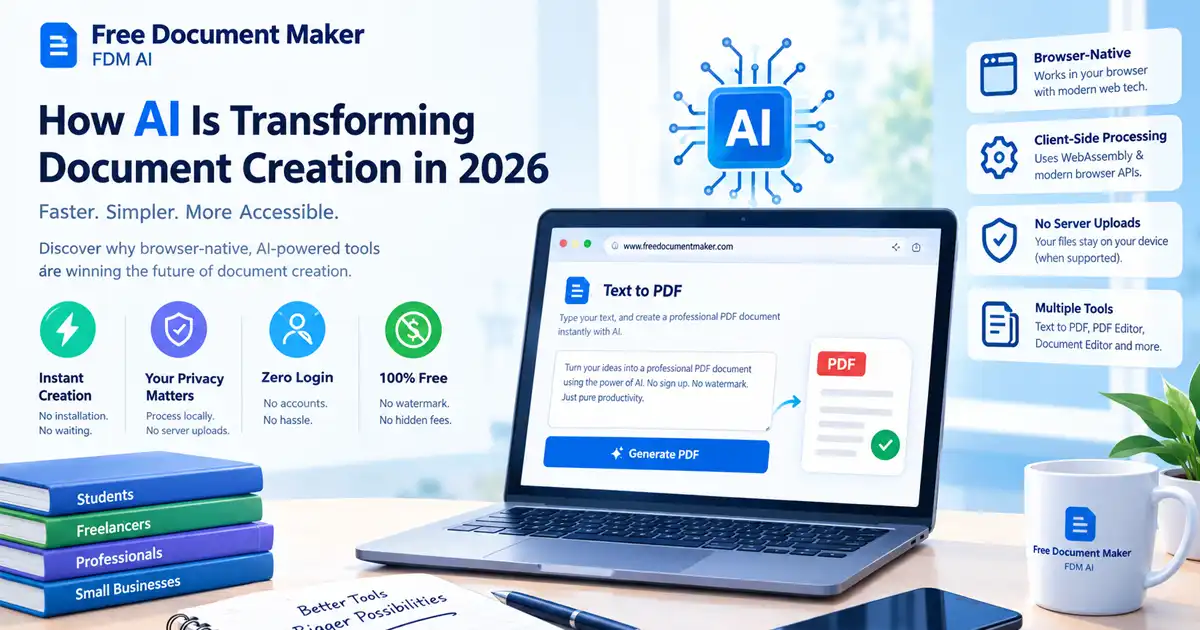
How are modern web platforms delivering instant performance without heavy servers? The secret lies in client-side document processing.
Modern browsers are no longer simple document viewers; they are powerful application runtimes. By leveraging technologies like WebAssembly (Wasm) and advanced JavaScript APIs, web utilities can execute complex data parsing, compression, and rendering directly within the user’s local browser sandbox.
This architecture allows computations to happen locally on the user's device hardware. As a result, processing speeds increase exponentially because there is no network latency or server queue waiting time.
4. Prioritizing User Privacy Through Local Architecture
In an era where data privacy is paramount, transparency regarding technical architecture is critical. Reliable web platforms do not rely on vague or exaggerated privacy claims. Instead, they implement secure local processing models.
Using client-side execution means helping protect user privacy by processing supported document operations locally in the browser without uploading files to a remote server. Because the data never leaves your local device environment during execution, the risk of interception or unauthorized storage is effectively neutralized.
5. Practical Implementation: The Rise of FDM AI and Modern Tooling
Platforms like Free Document Maker (FDM AI) exemplify this new wave of browser-based productivity. Rather than locking basic utilities behind corporate paywalls, FDM AI provides an ecosystem of specialized tools designed for specific micro-tasks.
Depending on your workflow needs, you can leverage various modular utilities across the platform:
If you need to compile raw text or prompt outputs into formatted files, use the Free Text to PDF Converter.
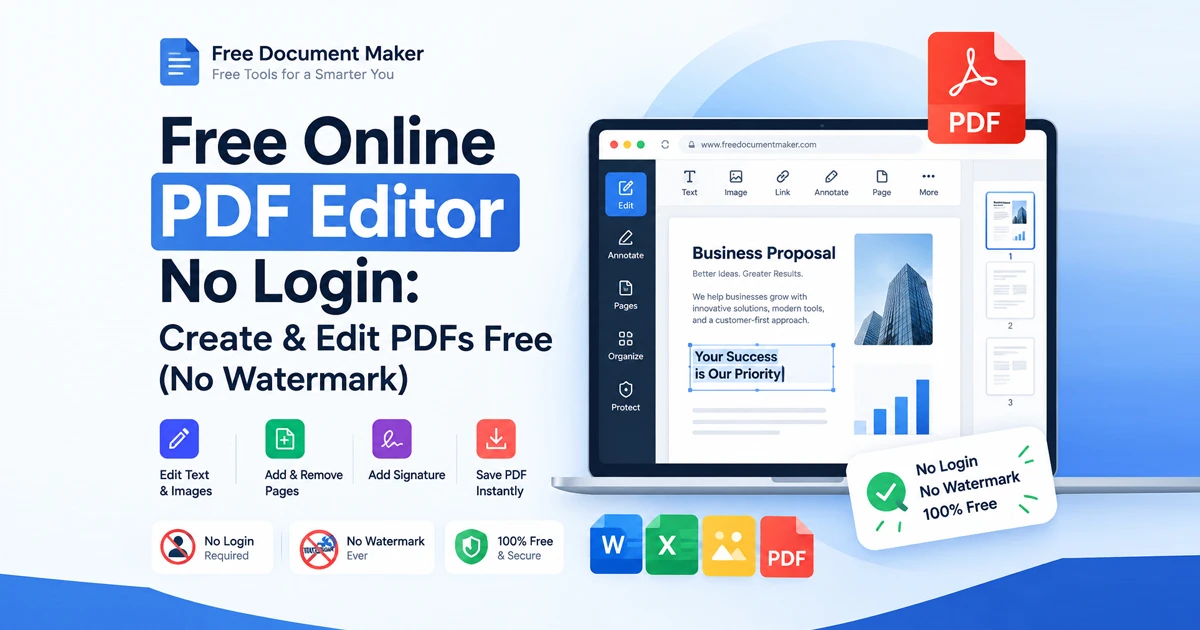
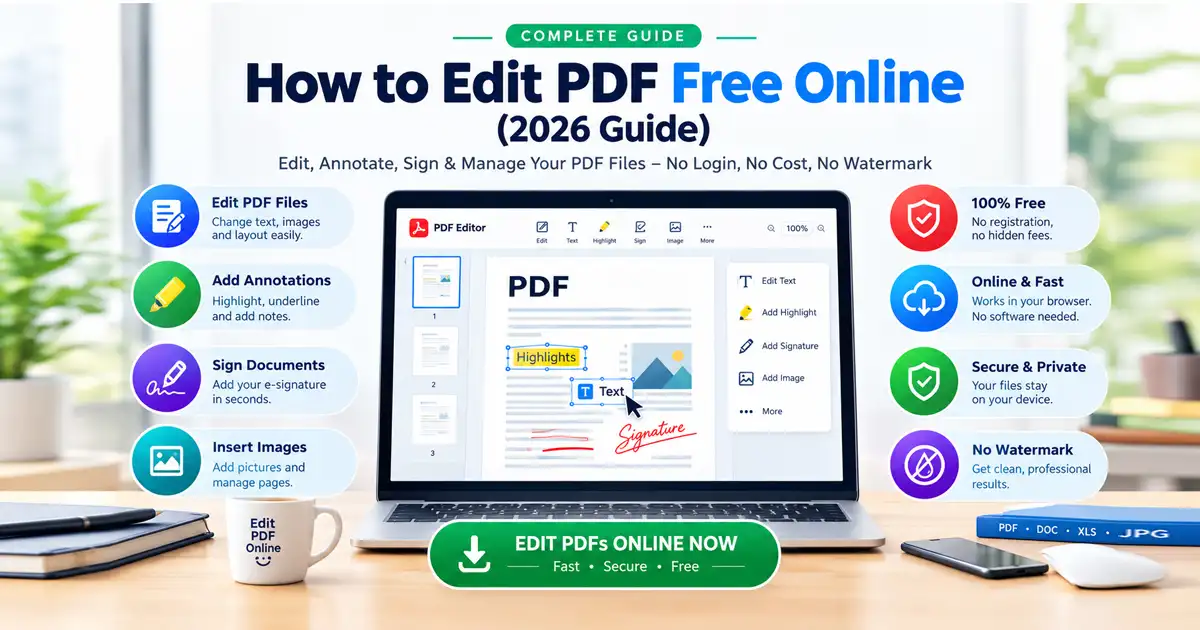
For modifying existing layouts, annotations, or structure, access the Online PDF Editor.
When drafting or structuring fresh content from scratch, utilize the AI Document Writer.
For general formatting and text adjustments, the Free Document Editor offers a seamless, zero-friction interface.
Conclusion: The Future of Frictionless Productivity
The evolution of document technology in 2026 proves that users no longer want heavy, subscription-heavy software for simple tasks. By mastering AI document creation through intelligent generative models and secure browser-native processing, digital workflows are becoming faster, cleaner, and completely private.
Embracing these modern browser-based PDF tools allows professionals and creators to reclaim their time, protect their data, and focus purely on what matters: creating great content.