FDM AI . 100% Secure Client Sandbox

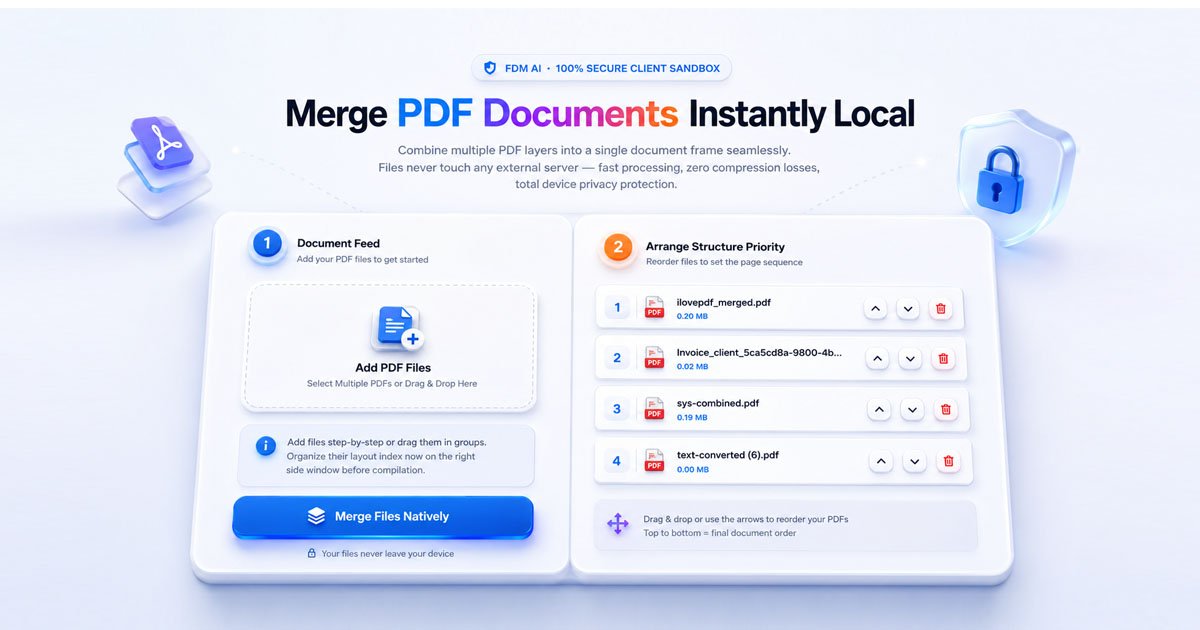
Merge PDF Documents Instantly Local

Combine multiple PDF layers into a single document frame seamlessly. Files never touch any external server — fast processing, zero compression losses, total device privacy protection.

1 Document Feed

Add PDF Files

Select Multiple PDFs • Drag & Drop Here

Add files step-by-step or drop them in groups. Organize their layout index row on the right side window before compilation.
Compiling Core Packets...

2 Arrange Structure Priority

Awaiting Document Matrix Streams...

Illustration of FDM AI PDF Merger processing multiple document buffer sequences, showcasing real-time file reordering and secure local assembly
Interactive demonstration dashboard of FDM AI PDF Merger executing multi-page document file array stacking, arrangement sorting, and binary stream compilation.
High-Speed Document Assembler • 100% Free

The Ultimate AI PDF Merger

The PDF Merger by FDM AI is a high-speed, client-side document assembly suite engineered to merge PDF files online seamlessly. Combine multiple multi-page document variants, concatenate payload buffers, and organize document hierarchies instantly while preserving the raw vector components, embedded fonts, and sub-pixel alignment of your original file schemas.

  • Concatenate Multi-Page Streams

    Effortlessly link infinite standalone sheets, bulk invoices, or heavy contract briefs together. Our in-memory array compiler parses separate binary payloads into a singular target file frame in milliseconds.

  • Dynamic Priority Sequence Sorting

    Take complete control over page execution orders. Utilize our reactive Alpine array module to shift structural file priority rows up or down smoothly, guaranteeing exact layout placement before final assembly.

  • Zero-Loss Cryptographic Integrity

    Never worry about warped fonts or layout shifts. The pdf-lib engine extracts original object vectors, protecting embedded interactive checkboxes, high-res photos, and multi-layer script parameters cleanly.

Open PDF Merger Client-side document compiler, interactive sequence arranger arrays, and byte chunk packing — 100% free with zero cloud logging rules.

FDM AI PDF Merger provides secure, zero-latency document compilation services engineered for workflows requiring fast file packaging, portfolio building, and clean multi-page blending. Instantly combine statement sheets, merge report files, and pack layout states safely within an isolated, local zero-trust browser execution profile.

3-Step Document Merging Pipeline

How FDM AI’s PDF Merger Works

Combine documents, sort page sequences, and compile unified files locally in seconds through three secure browser steps.

  1. Upload Multiple PDFs

    Select or drag multiple PDF documents directly from your device. Your files are initialized instantly inside safe browser memory maps.

  2. Arrange Sorting Order

    Shift document priority rows up or down smoothly using reactive sorting controls to organize your final layout hierarchy.

  3. Merge & Save File

    Trigger the local pdf-lib compiler to concatenate the data streams into a single uncompressed PDF file instantly.

Knowledge Base

Frequently Asked Questions — PDF Merger

Find clear answers about FDM AI’s core document compilation framework — how to safely combine pages, sort sequences, maintain original vectors, and protect your data privacy.

  • Q

    What is the pdf merger FDM AI platform?

    It is a highly secure, browser-native pdf merger online framework engineered to execute a clean pdf merge operation locally. Powered by client-side processing matrices, it stacks separate document configurations into a single output file stream without exposing raw file assets to remote server tracking modules.

  • Q

    Is this free pdf merger workspace truly unrestricted?

    Yes, you can merge pdf free with absolutely no account registration, usage ceilings, or watermarks. This provides a completely premium, zero-cost pdf merger free ecosystem where users can process multiple complex documents, arrange prioritized row configurations, and compile unified files smoothly.

  • Q

    Does an action to combine pdf structures degrade layout resolution?

    No. When you merge pdf files via this client-side module, the underlying engine securely extracts the original vector coordinates, typography structures, and annotation bounds. It duplicates the raw binary arrays directly into a new document buffer to preserve absolute font sharpness and edge contrast.

  • Q

    Can I process records containing different sizes like A4 and Letter?

    Yes. Our local layout architecture handles mixed sheet dimensions cleanly. The sandbox system executes a routine to merge document arrays while capturing the exact physical point metrics of each individual page, keeping native proportions intact without force-warping.

  • Q

    Is it safe to merge pdf online using highly confidential legal contracts?

    Absolute device-level security is guaranteed. While traditional cloud platforms force you to upload payloads, our interface allows you to safely execute a clean file merge inside temporary browser memory channels, ensuring your secure files never touch external storage networks.

  • Q

    Can I rearrange the structural order of files after uploading them?

    Yes. Our layout integration features an interactive Alpine.js array prioritization script. You can use the explicit Move Up and Move Down button controllers to reorder your timeline layout instantly before generating the compiled output file.

  • Q

    Does this tool support merging encrypted or password-protected PDFs?

    No. To uphold strict document authentication rules, our browser-native script cannot read locked byte arrays. You must decode or remove password-protection flags from the source metadata layers before dropping them into the processing dropzone.

  • Q

    Is there a limit on the number of pages or file size I can merge?

    There are no artificial limits built into the framework. Processing speeds and page counts scale seamlessly with your local device's hardware RAM pool. The sandboxed compiler easily constructs aggregations of hundreds of pages directly in active memory.