The Shift Toward Intelligent Document Creation
The era of manual document formatting is rapidly fading.
For decades, document creation relied on static tools — word processors, templates, and manual formatting workflows. While effective, these systems required time, effort, and constant revision.
Today, artificial intelligence is changing that foundation completely.
Modern document systems are no longer passive tools. They are becoming intelligent collaborators — systems capable of understanding context, structure, and user intent before a single sentence is finalized.
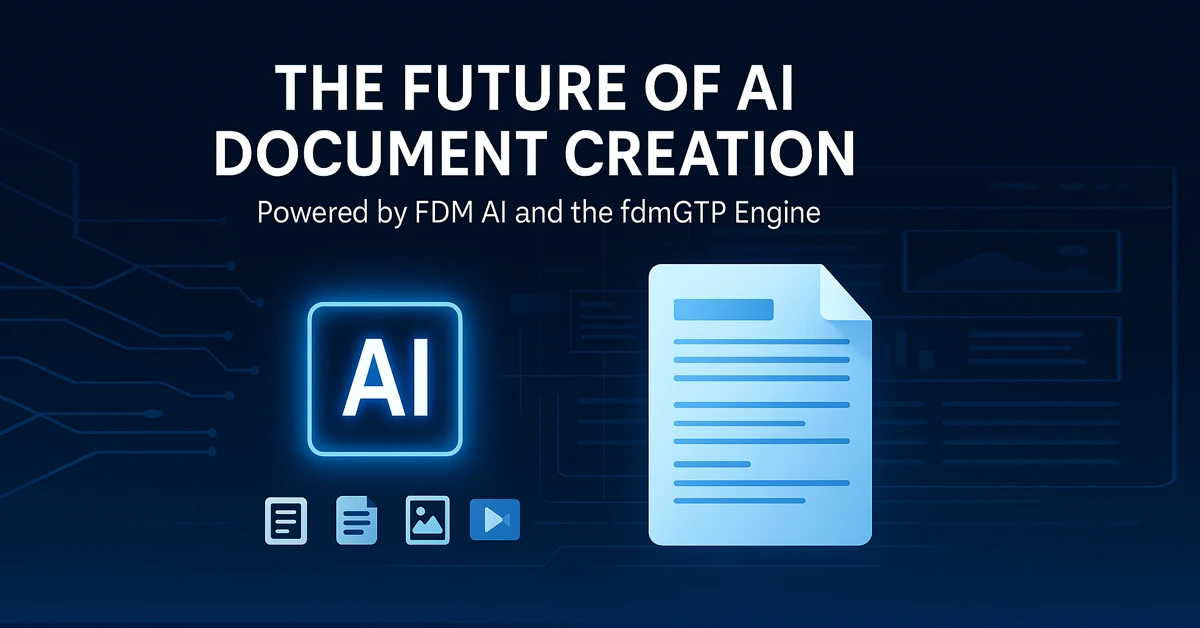
At the forefront of this transformation is FDM AI, powered by its proprietary fdmGTP engine — an advanced language-understanding framework that converts raw ideas into structured, professional documents within seconds.
This shift marks the beginning of a new era: AI-native document creation, where documents are no longer manually built but intelligently generated and continuously refined.
1. From Automation to Intelligence
Early digital tools focused on automation.
They helped users format text, apply templates, and manage layout — but they did not understand the content itself.
Today’s AI-powered systems go beyond automation. They interpret meaning.
The fdmGTP architecture combines natural language understanding with layout intelligence, enabling real-time alignment between content, tone, and structure.
Instead of relying on fixed templates, users can now:
Generate outlines that dynamically adapt to the topic and purpose
Maintain consistent tone and formatting across multiple sections
Automatically insert relevant content blocks, such as summaries, lists, or data sections
This evolution transforms document creation into a semantic workflow, where the system understands what you want to say — not just how to format it.
2. Context-Aware Creation
One of the biggest limitations of traditional tools is their inability to understand context.
A résumé, a business proposal, and a technical report may share structural similarities, but they differ significantly in tone, purpose, and audience.
The fdmGTP contextual engine addresses this challenge.
It analyzes relationships between words, sections, and objectives to determine how a document should be structured and presented.
This allows FDM AI to:
Adjust tone based on document type (formal, technical, conversational)
Align content with audience expectations
Maintain logical flow across sections
As a result, documents feel intentionally crafted rather than automatically generated.
This level of contextual awareness is what defines the next generation of intelligent document systems.
3. Documents That Learn and Evolve
Traditional documents are static.
Once created, they require manual updates, revisions, and restructuring.
AI-powered documents are different.
With adaptive memory and reasoning layers, FDM AI enables documents to evolve over time.
This includes the ability to:
Update numerical or analytical data from external inputs
Re-summarize sections when new information is added
Translate content across languages while preserving tone and meaning
Adapt content for different formats or audiences
Through fdmGTP’s adaptive intelligence, a single document can transform into multiple outputs — reports, summaries, presentations, or structured briefs.
Documents are no longer fixed files — they become living systems that grow alongside your workflow.
4. Collaboration Without Barriers
Modern work is collaborative, but traditional tools often create friction.
Version control issues, formatting inconsistencies, and fragmented workflows slow down productivity.
The fdmGTP engine eliminates these barriers by integrating writing, formatting, and content intelligence into a single system.
Multiple users can collaborate in real time while the AI ensures:
Consistent tone and style
Structured formatting across contributors
Logical flow and coherence
There is no need for plugins, manual corrections, or complex coordination.
This model of AI-assisted collaboration allows teams to focus on clarity, accuracy, and results rather than process.
5. Human Creativity, Machine Precision
A common misconception is that AI replaces human creativity.
In reality, it enhances it.
FDM AI is designed to amplify human capability, not replace it.
By automating repetitive and structural tasks, it allows users to focus on:
Strategic thinking
Creative expression
High-level decision-making
At the same time, fdmGTP improves readability, grammar, and structure, ensuring every document meets professional standards.
This balance between creativity and precision is what makes AI document tools truly powerful.
6. The Road Ahead — Intelligent Workspaces
The future of AI document creation goes beyond text.
It is evolving toward intelligent workspaces — unified environments where documents, data, and media are seamlessly integrated.
FDM AI represents this next phase.
It connects writing, formatting, conversion, and output into a single workflow where users can create, edit, and deploy content without switching tools.
In the near future, the fdmGTP engine will expand to support:
Presentations and slide generation
Spreadsheet automation and data analysis
Multimedia content creation and conversion
This leads to a powerful concept:
Create once, deploy everywhere.
A single input can generate multiple outputs across formats and platforms.
7. SEO, Accessibility, and Performance in AI Documents
Another key advantage of AI document systems is optimization.
Modern AI tools like FDM AI ensure documents are:
Structured for readability and clarity
Optimized for accessibility standards
Designed for fast rendering and performance
Aligned with SEO-friendly formatting principles
This means documents are not only easier to create but also more effective when published or shared online.
Conclusion
The future of AI document creation is defined by adaptive intelligence, contextual understanding, and automation at scale.
Documents are no longer static files — they are evolving into intelligent systems that understand, adapt, and improve continuously.
FDM AI and its fdmGTP engine represent this transformation.
They go beyond traditional tools by combining language understanding, layout intelligence, and real-time adaptability into one unified system.
The result is faster workflows, better content quality, and a more efficient way to create and manage information.
Closing Note
The intelligence behind the next generation of document creation is already here.
Experience the power of fdmGTP-driven workflows through FDM AI — your all-in-one environment for intelligent writing, formatting, and automation.
👉 Explore more:
https://www.freedocumentmaker.com
https://aidocsuite.com