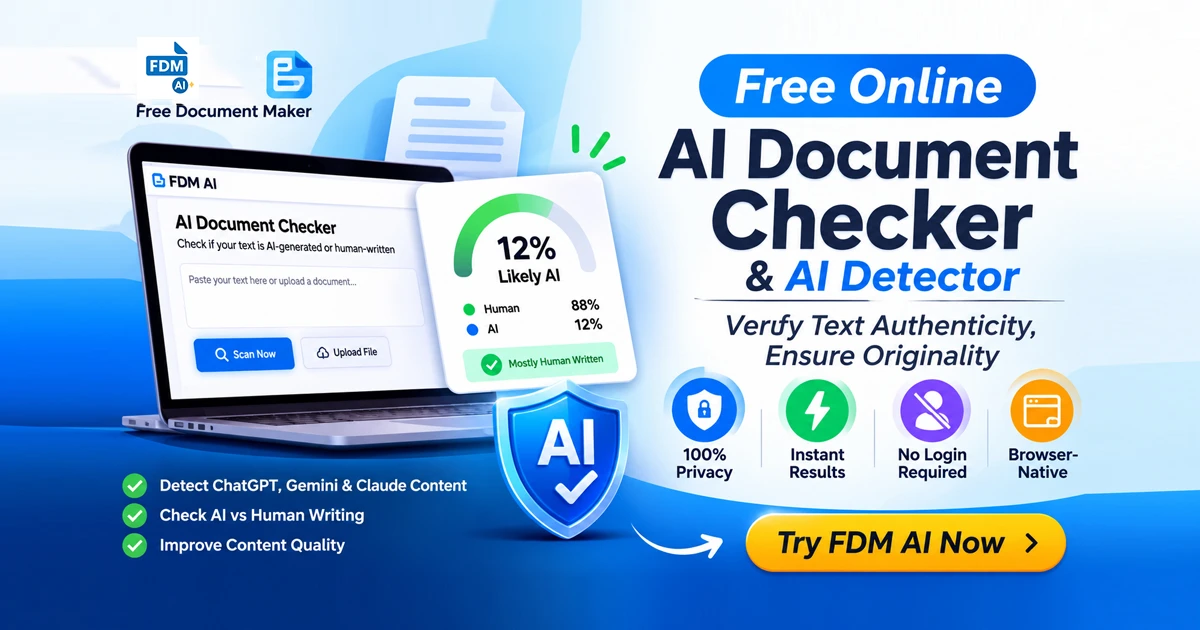
In today's fast-paced digital era, artificial intelligence has fundamentally altered how content is drafted, edited, and published. While AI tools provide unprecedented speed for writing assistance, verifying whether text was composed by a human or generated by an AI model has become essential for educators, students, content strategists, publishers, and legal professionals alike. Using a reliable Free AI Document Checker allows you to audit text patterns, maintain editorial standards, and preserve authentic communication—all while protecting your document privacy.
1. Understanding Detection Accuracy: The Truth About False Positives & Google Penalties
A common misconception in digital publishing is that Google automatically penalizes any content containing AI-generated text. In reality, Google's search algorithms focus primarily on content quality, originality, and user value—regardless of whether it was written solely by a human, polished by AI, or created collaboratively.
However, it is equally vital to understand that no AI detector on the market is 100% accurate. AI text detection relies on statistical probability rather than definitive proof. As a result, detection tools can sometimes produce False Positives—misidentifying original, well-structured human writing as AI-generated text. Because formal academic writing, technical documentation, and standardized language naturally follow predictable patterns, they are particularly susceptible to false flags. Therefore, an AI document checker should always be treated as an estimation tool to guide human review, rather than an absolute verdict.
2. Technical Explanation: How Perplexity and Burstiness Work
Modern AI detection engines do not simply check text against a database of known phrases. Instead, they analyze core linguistic metrics to determine structural predictability. The two most critical parameters evaluated are Perplexity and Burstiness:
Perplexity (Unpredictability of Word Choice): Perplexity measures how complex or unpredictable a piece of text is to a language model. Large Language Models (LLMs) operate by choosing the statistically most probable next word in a sequence. Consequently, AI-generated text typically exhibits low perplexity. Human writers, on the other hand, frequently use creative metaphors, unexpected vocabulary, and unique phrasing, resulting in significantly higher perplexity scores.
Burstiness (Structural Sentence Variation): Burstiness measures variations in sentence length, rhythm, and structure across a document. Human writers naturally alternate between short punchy sentences, medium-length clauses, and long complex observations. In contrast, AI models generate sentences with uniform length, predictable cadence, and repetitive structural pacing, creating low burstiness across paragraphs.
By evaluating the interaction between perplexity and burstiness, an AI text detector generates an overall probability score indicating the likelihood of AI assistance.
3. AI Detector vs. Plagiarism Checker: What is the Difference?
Although both tools are designed to safeguard content integrity, an AI Detector and a Plagiarism Checker serve completely different purposes:
Feature | AI Detector | Plagiarism Checker |
Primary Focus | Identifies statistical patterns of language models | Detects verbatim or paraphrased copied text |
Database Match | Does not match text against online databases | Cross-references text against indexed web pages and academic archives |
Detection Method | Evaluates structural metrics (Perplexity & Burstiness) | Scans for exact word matches and sentence overlap |
Main Target | Uncredited AI output (ChatGPT, Gemini, Claude) | Copyright infringement, intentional theft, and academic copy-pasting |
Using both tools in tandem ensures that your documents are both original in source and natural in delivery.
4. Privacy-First Security: The Power of 100% Client-Side Processing
Many conventional online tools require you to submit your private essays, corporate reports, or proprietary code to remote cloud servers. This exposes sensitive files to server logging, unexpected data storage, and potential third-party security vulnerabilities.
The FDM AI framework solves this privacy risk by using 100% Client-Side Processing. When you run your text through the Free AI Document Checker, all parsing, statistical calculations, and structural checks occur entirely within your web browser's local memory.
Zero Server Uploads: Your text and documents never leave your computer or mobile device.
No Data Retention: No logs, session records, or cloud copies are kept after you close your tab.
Instant Speed: Eliminating external server uploads yields instant processing speeds, even for long-form papers.
5. How to Use the Free AI Document Checker in 3 Simple Steps
Verifying document authenticity and auditing structural flow takes only seconds:
Paste or Upload Content: Copy your plain text into the browser input field or select your target document file.
Execute Local Analysis: Click the scan button to let the client-side engine calculate perplexity and burstiness metrics.
Review & Refine: Analyze the structural breakdown, review flagged sentences, and manually refine any rigid or repetitive phrasing to restore natural human expression.
6. Frequently Asked Questions (FAQ)
Q1: Is a Free AI Document Checker 100% accurate?
No. AI text detectors provide statistical estimates based on structural patterns, not absolute proof. Always combine automated scores with manual editorial review.
Q2: Can original human writing be flagged as AI-generated?
Yes. Highly structured, technical, or formal human writing can occasionally trigger false positives due to uniform sentence length and low perplexity scores.
Q3: Are my uploaded documents saved on any external servers?
No. Thanks to FDM AI's client-side architecture, your documents are processed locally inside your web browser and are never uploaded or saved to remote cloud servers.
Q4: Does using this tool require registration or account fees?
No. You can access the tool completely free without signing up, installing desktop software, or providing personal credentials.
Q5: Which AI language models can this tool evaluate?
The underlying detection algorithms analyze generic structural metrics common to major language models, including ChatGPT (GPT-4), Claude, Gemini, and Copilot.
7. Streamline Your Workflow with FDM AI Tools
Beyond content verification, you can manage and optimize your digital workspace using our suite of privacy-focused browser utilities:
Compress PDF Documents: Reduce large file sizes locally without sacrificing quality using the FDM AI PDF Compressor.
Complete Workspace Suite: Explore all document creation, editing, and conversion features at the FDM AI PDF Suite.