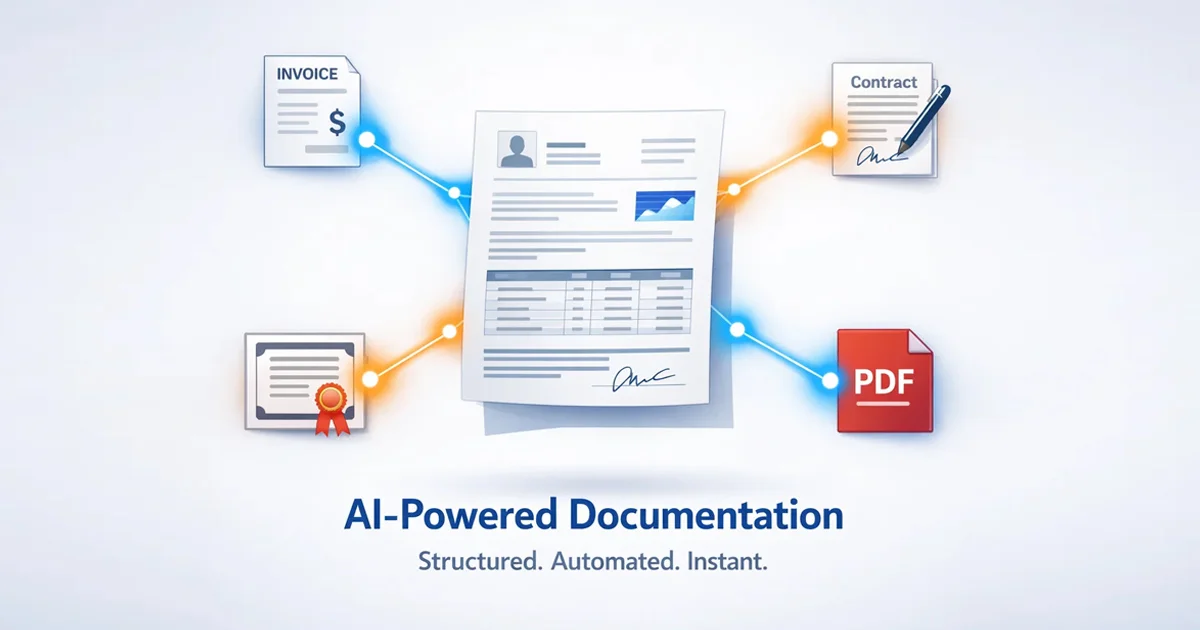
AI-powered documentation is rapidly redefining how businesses, freelancers, and students create professional documents. Instead of manually drafting, formatting, and exporting files, modern platforms now use artificial intelligence to automate document generation, structuring, and conversion.
In 2026, productivity tools are expected to function instantly. Users no longer want heavy software installations or subscription barriers. They expect browser-native systems that generate structured documents in seconds.
This is where AI-powered documentation becomes essential.
What Is AI-Powered Documentation?
AI-powered documentation refers to the use of artificial intelligence to generate, structure, format, and manage documents automatically based on structured inputs.
Rather than writing everything manually, users provide data or prompts, and the AI system:
Structures sections logically
Applies consistent formatting
Generates export-ready output
Converts files between formats
Optimizes layout automatically
AI-powered documentation eliminates repetitive manual tasks and reduces formatting errors.
How AI-Powered Documentation Works
At a technical level, AI-powered documentation systems combine:
Natural Language Processing (NLP)
Structured data parsing
Template automation
Document rendering engines
File conversion logic
Instead of producing raw text, advanced platforms generate structured documents ready for download in formats like PDF, Word, or image files.
This is the difference between simple AI text generation and real AI-powered documentation.
The Shift from Manual Formatting to Intelligent Automation
Traditional document workflows required:
Opening desktop software
Creating layouts manually
Adjusting margins and spacing
Reformatting exported PDFs
Converting files separately
AI-powered documentation removes these steps by embedding formatting intelligence directly into the generation process.
This dramatically improves:
Speed
Accuracy
Workflow consistency
Cross-device compatibility
AI-Powered Documentation in Free Document Maker
Free Document Maker applies AI-powered documentation through its proprietary fdmGTP engine.
The system combines structured input logic with browser-native processing to generate professional documents instantly — without requiring login or subscription access.
How It Works on Free Document Maker
User enters structured information (invoice data, agreement details, certificate content, etc.)
fdmGTP processes the data
The platform applies automated formatting
Users download a clean, watermark-free file
This workflow transforms document creation from manual editing into intelligent automation.
Real-World Examples of AI-Powered Documentation
On Free Document Maker, AI-powered documentation includes:
Invoice generation with automated totals and formatting
Agreement drafting with structured legal sections
Certificate design with printable layout formatting
PDF merging, splitting, and compression
Image-to-PDF conversion
Word count and readability analysis
Each tool reflects a specific implementation of AI-powered documentation.
Why AI-Powered Documentation Matters in 2026
Modern users demand:
Instant execution
No onboarding friction
Watermark-free exports
Cross-device compatibility
Privacy-first processing
AI-powered documentation addresses these expectations by:
Eliminating manual formatting
Reducing repetitive writing tasks
Automating document logic
Enabling browser-native workflows
As businesses increasingly rely on lightweight web tools, AI-powered documentation becomes a foundational productivity layer.
AI-Powered Documentation vs Traditional SaaS Platforms
Feature | AI-Powered Documentation | Traditional Document Software |
|---|---|---|
Automation | Built-in AI structuring | Mostly manual |
Access | Browser-native | Often software-based |
Speed | Instant generation | Manual formatting required |
Conversion | Integrated | Separate tools needed |
Workflow | Structured automation | Fragmented processes |
This transition marks a broader evolution in digital productivity.
The Future of AI-Powered Documentation
AI-powered documentation will continue evolving toward:
Real-time adaptive formatting
Context-aware document generation
Multi-format export pipelines
Fully browser-native execution
Intelligent workflow orchestration
Platforms that integrate automation deeply — rather than adding AI as a surface feature — will define the next generation of document tools.
Frequently Asked Questions About AI-Powered Documentation
What makes AI-powered documentation different from AI writing?
AI writing generates text.
AI-powered documentation generates structured, formatted, export-ready documents with embedded logic.
Is AI-powered documentation only for developers?
No. While some systems generate technical documentation, platforms like Free Document Maker apply AI-powered documentation to invoices, agreements, certificates, and PDF workflows.
Does AI-powered documentation replace human input?
No. Users still provide structured information. AI accelerates formatting, structuring, and conversion processes.
Can AI-powered documentation improve productivity?
Yes. By removing repetitive formatting tasks and reducing workflow friction, AI-powered documentation significantly increases efficiency.
Is AI-powered documentation secure?
Security depends on the platform. Browser-native systems that minimize file storage and avoid mandatory account systems enhance privacy.
Conclusion
AI-powered documentation represents the next phase of digital productivity. By combining intelligent automation, structured formatting, and browser-native processing, it reduces friction and accelerates document workflows.
Free Document Maker (FDM AI) applies AI-powered documentation through fdmGTP to deliver fast, structured, watermark-free document generation without login barriers.
As user expectations shift toward instant-access tools, AI-powered documentation will continue shaping how professionals create and manage digital files.