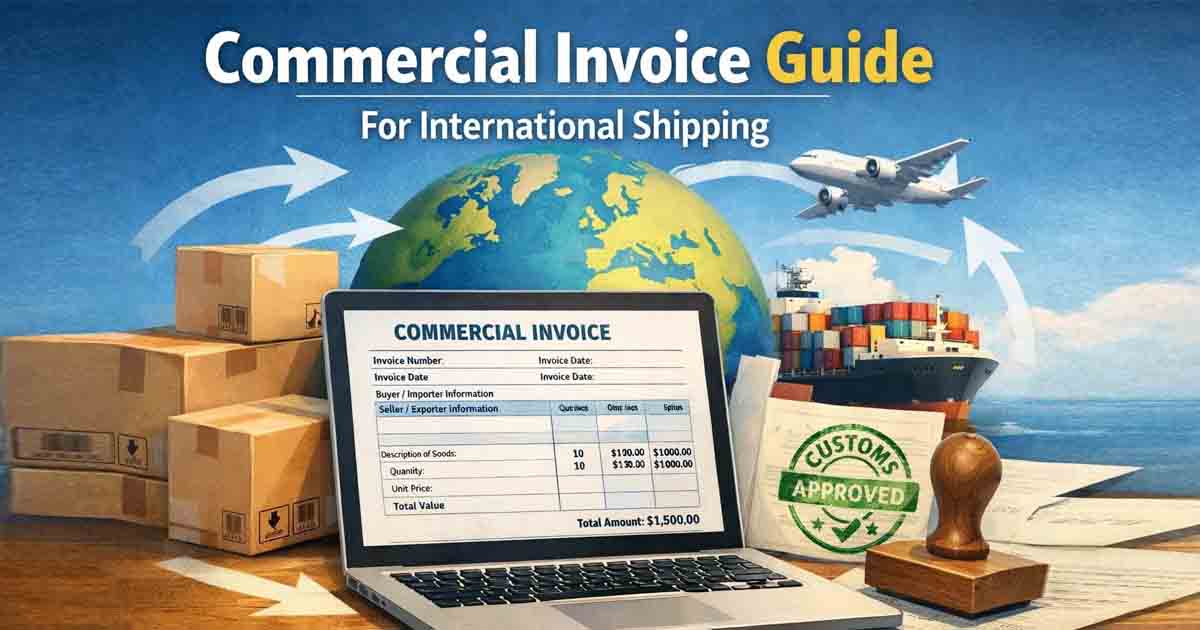
If you're shipping goods across international borders, a standard invoice is not enough. International trade requires a commercial invoice that meets customs regulations and shipping documentation standards.
This document plays a critical role in global logistics. Customs authorities rely on the commercial invoice to determine duties and taxes, verify shipment details, and ensure compliance with international import and export laws.
Without a properly prepared invoice, shipments may be delayed, inspected, or even rejected by customs officials.
What Is an International Shipment Invoice?
An international shipment invoice—commonly known as a commercial invoice—is a legally recognized export document used during cross-border trade.
It provides customs officials with detailed information about the goods being transported, including their commercial value, country of origin, buyer and seller details, and the terms of the transaction.
Shipping carriers such as DHL, FedEx, UPS, and international freight forwarders require this document before processing most international shipments.
The commercial invoice also serves as a financial record between the exporter and importer and may be used by banks when processing international payments through trade finance or letters of credit.
Required Fields in an International Invoice
1. Exporter and Importer Information
The invoice must clearly identify both parties involved in the transaction. Include the full business name, address, country, email address, and phone number for both the exporter (seller) and importer (buyer).
Some countries also require company registration numbers or tax identification numbers for customs verification.
2. Invoice Number and Date
Every commercial invoice should include a unique invoice number and the date the document was issued. This helps customs officials track the shipment and allows businesses to maintain proper accounting records.
The invoice number is also used in shipping documentation such as packing lists, airway bills, and bills of lading.
3. Description of Goods
Provide a clear and detailed description of each product included in the shipment. Vague descriptions such as “goods” or “samples” can cause customs delays.
This section should include:
• Product name
• Quantity of items
• Unit price
• Total commercial value
• Net or gross weight
• Dimensions or volume (when relevant)
Most international shipments should also include the HS Code (Harmonized System Code). This globally recognized classification system helps customs authorities determine the correct duty rates and import regulations for the product.
4. Country of Origin and Destination
The invoice must state where the goods were manufactured or produced. This is known as the country of origin.
Customs agencies use this information to apply trade agreements, import restrictions, or tariff rates.
You should also clearly identify the destination country where the shipment will be delivered.
5. Currency and Total Invoice Value
The commercial invoice must specify the currency used for the transaction, such as USD, EUR, GBP, or other international currencies.
It must also show the total value of the goods in the shipment. Customs authorities use this value to calculate import duties, taxes, and customs fees.
6. Incoterms and Payment Terms
Incoterms (International Commercial Terms) define the responsibilities of buyers and sellers in international trade.
These terms specify who is responsible for shipping costs, insurance, customs clearance, and delivery risks.
Common examples include:
• EXW – Ex Works
• FOB – Free On Board
• CIF – Cost, Insurance, and Freight
• DDP – Delivered Duty Paid
You should also specify the payment terms, such as advance payment, net 30 days, or payment upon delivery.
7. Signature and Declaration
Most commercial invoices include a declaration confirming that the information provided is accurate and that the goods comply with export regulations.
The invoice should be signed by an authorized representative of the exporting company.
Some countries require a printed name, title, and official company stamp as part of the declaration.
Additional Information That May Be Required
Depending on the country and type of shipment, customs authorities may require additional details such as:
Buyer’s purchase order or reference number
Tax ID, VAT number, or EORI number
Freight and insurance costs
Shipping method (air, sea, or courier)
Contact person for customs inquiries
Providing these details helps reduce the risk of customs delays and improves shipment transparency.
Create International Shipping Invoices Instantly
Preparing compliant international invoices manually can be time-consuming and prone to errors.
You can generate professional documents instantly using the Free Invoice Generator.
This tool allows you to quickly create structured invoices with all required business fields and download them as clean PDF documents.
If you need to correct an invoice or process a refund, the Credit Note Generator can generate compliant credit memos.
For shipments that require an official preliminary document before payment or dispatch, the Proforma Invoice Generator allows you to create a professional proforma invoice instantly.
Final Compliance Checklist
Before sending an international shipment, verify that your invoice includes the following information:
Exporter and importer information
Detailed product descriptions and HS codes
Invoice number and issue date
Currency and total invoice value
Incoterms and payment terms
Authorized signature and declaration
Accurate documentation helps prevent customs delays, avoids unexpected import fees, and ensures smooth international shipping operations.
Explore more document tools:
Free Document Maker — AI-Powered Invoice & Document Tools