fdmGTP is the specialized engine solving the greatest paradox in 2026 Artificial Intelligence: the gap between thinking and formatting. While you can ask GPT-5 to draft a legal contract or use Gemini 3 to analyze a spreadsheet, these general models almost always fail at the finish line. They provide the "thinking," but they cannot provide the structure. Professional results require a specialized AI document writer that understands more than just language.
In the spring of 2026, we have reached a bizarre paradox in Artificial Intelligence. You can ask GPT-5 to draft a 10-page Master Service Agreement or use Gemini 3 to analyze a thousand-line financial spreadsheet, and they will perform with PhD-level reasoning. However, the moment you ask them to turn that text into a professional, print-ready PDF, the system breaks. You get "messy" text, broken tables, and margins that look like they were designed in the early 90s.
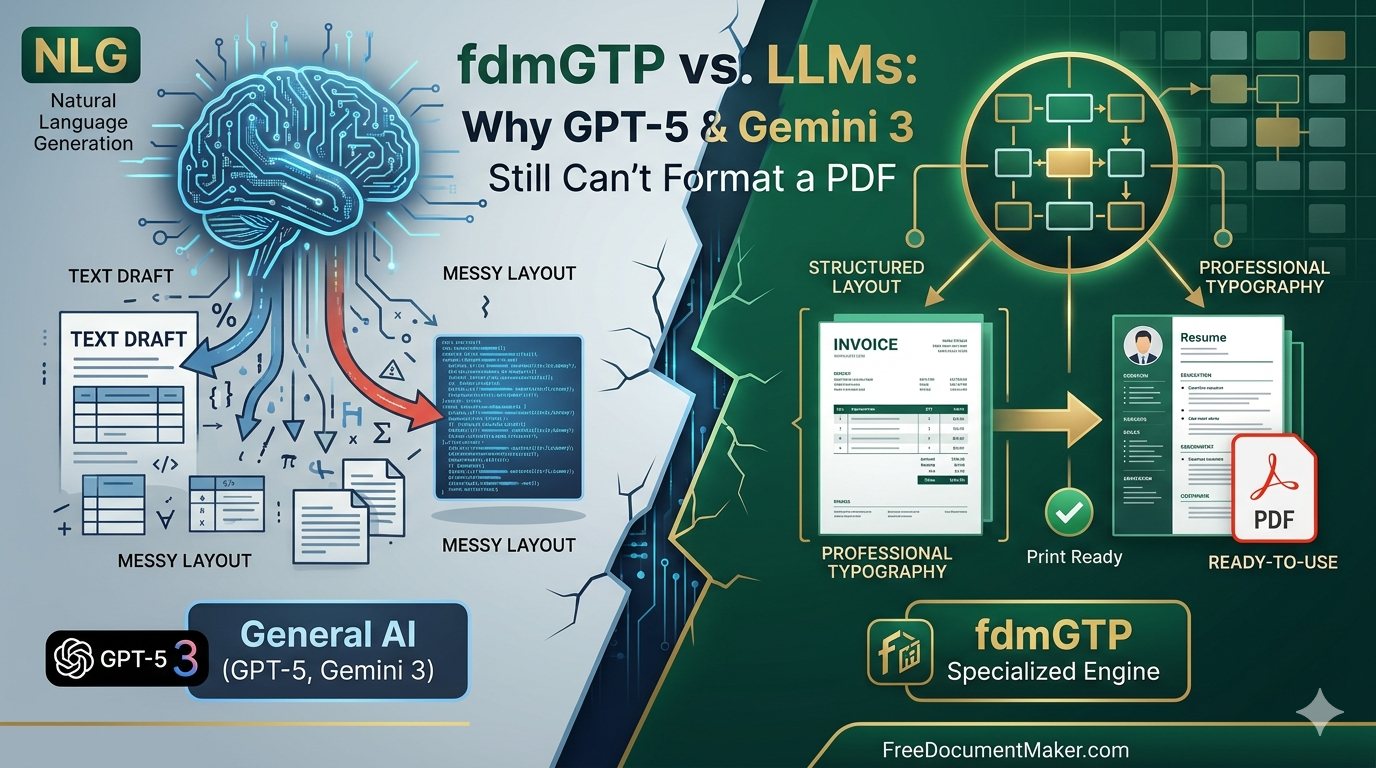
Why can the smartest machines in history understand the law but not a simple document layout? The answer lies in a technical "Missing Link": the gap between Natural Language Generation (NLG) and Document Object Model (DOM) structuring. This is where the fdmGTP engine steps in to provide the spatial intelligence general models lack.
1. The Technical Divide: NLG vs. DOM
To understand why your AI-generated resume looks "off," you have to understand the architectural difference between how AI thinks and how documents behave. General chatbots are built for conversation, while tools like AI text-to-document generators are built for architecture.
The "Thinker": Natural Language Generation (NLG)
This is the heart of models like ChatGPT and Gemini. They are built for fluidity. Their goal is to predict the next best word based on a massive statistical understanding of human language. They are experts at what to say, but they treat text as a continuous stream of tokens rather than a physical object.
The "Builder": Document Object Model (DOM) Structuring
This is the science of spatial architecture. A professional document isn't just a string of words; it’s a hierarchy of containers, bounding boxes, specific font weights, and precise padding. Professional layouts require deterministic precision—where a logo is exactly 2cm from the top, and text wraps perfectly around an image. This spatial logic is a core part of the automation features found in specialized engines.
The Conflict: LLMs are probabilistic (they guess). Formatting is deterministic (it must be exact). When an LLM tries to "guess" a layout using Markdown or plain text, you get the "Messy Text Syndrome"—interleaved columns, collapsed tables, and font sizes that change without logic.
2. Why GPT-5 and Gemini 3 Still "Fail" at Layout
Even with the 2026 updates to GPT-5’s "Thinking Mode" and Gemini 3’s Multimodal Flash, the "Action Gap" remains. These models are primarily trained on the web, where content is responsive and fluid. Paper, however, is fixed. Converting high-level thought into a physical file requires a dedicated text-to-PDF pipeline.
When you copy-paste a contract from a chatbot, you aren't copying a "document"; you are copying a "draft."
Hallucinated Formatting: AI often creates visual elements (like bullet points or headers) that look okay on a screen but overlap when converted to a PDF coordinate system.
The "Copy-Paste" Tax: Most professionals spend more time fixing an AI’s formatting in Word than they did writing the original prompt.
Lack of Spatial Intelligence: A general LLM doesn't "know" that a signature line should never be orphaned on a page by itself. It only knows that the word "Signature" usually follows the word "Sincerely."
3. Introducing fdmGTP: The Specialist Engine
This is where general-purpose AI ends and Specialized Document AI begins. At Free Document Maker (FDM AI), we realized that the world didn't need another chatbot. It needed an architect. We developed fdmGTP, a proprietary, browser-native AI engine specifically designed to bridge the NLG-DOM gap.
Unlike general LLMs, fdmGTP is trained on Structure, Layout, and Typography.
Layout-Aware Intelligence: fdmGTP doesn't just "read" words; it understands the semantic relationship between a header, a tax ID, and a footer. It knows exactly where each element belongs on a standard A4 or Letter-sized page.
Native PDF Architecture: It bypasses the messy "Markdown-to-Word-to-PDF" pipeline. It generates the document architecture directly in your browser using precise coordinate mapping via our text-to-PDF tool.
Privacy-by-Design: Because fdmGTP is browser-native, the "thinking" and "formatting" happen locally. Your sensitive business contracts or personal resumes never need to be uploaded to a third-party server for processing.
4. The "Final Step" Workflow: Stop Fighting with Copy-Paste
The secret to professional productivity in 2026 isn't finding one AI to do everything—it's using the right AI for the right stage. "Stop fighting with copy-paste: How specialized document AI finishes the job general AI starts."
Draft with the Titans: Use GPT-5 or Gemini 3 for the "heavy thinking"—researching legal clauses, summarizing interview notes, or calculating invoice totals.
Verify with Logic: Ask the AI to refine the tone or check for factual consistency.
Finalize with fdmGTP: Take that raw intelligence to Free Document Maker. Use the fdmGTP-powered suite to select your tool. The engine will automatically map your raw text into a professional, watermark-free structure using advanced automation features.
5. Why Browser-Native AI is the 2026 Standard
In an era of rising subscription fatigue and data privacy concerns, fdmGTP represents a shift toward Utility AI.
No Registration: Why create an account just to format a single receipt?
Zero Latency: Since the engine runs in your browser, there is no "server is busy" message.
Universal Compatibility: Whether you are on a Chromebook, a mobile device, or a high-end workstation, fdmGTP ensures your document looks identical on every screen.
The Verdict
If you need a brainstorm, call a chatbot. If you need a document, use an engine. As we move deeper into 2026, the winners won't be those who write the best prompts—they will be the people who use Specialized Document AI to convert raw intelligence into finished, professional products.
Experience the power of specialized formatting. Let the big AIs do the thinking, and let fdmGTP do the building. Try our AI text-to-document engine now at FreeDocumentMaker.com.