The legal profession has always been built on precision, structure, and documentation. But for solo practitioners and small firms, the reality behind that professionalism is often overwhelming. Every matter can generate a new stack of contracts, notices, revisions, agreements, research notes, follow-up letters, and internal summaries. For larger firms, much of that workload is distributed across teams. For solo lawyers, it often lands on one person.
This is exactly where AI legal drafting is starting to make a real difference.
Instead of spending hours formatting documents, rewriting repetitive clauses, or searching through old folders for a previous version of a similar agreement, lawyers can now use modern browser-based tools to generate structured first drafts in far less time. The value is not in replacing legal judgment. The value is in removing mechanical friction, so the lawyer can focus on analysis, negotiation, client advice, and case strategy.
What Is AI Legal Drafting?
AI legal drafting refers to using artificial intelligence to help generate, organize, refine, and improve legal documents based on instructions, context, and structured input.
Unlike static templates, AI-assisted drafting is more flexible. A normal template gives you the same starting point every time and forces you to manually edit names, conditions, clauses, and formatting. AI, by contrast, helps generate a more tailored foundation from the beginning.
For solo practitioners, this can be useful when preparing contracts, demand letters, summaries, client-facing explanations, internal memos, and customized agreements. With tools like Create Document Online, lawyers can start a structured document directly in the browser. When a matter requires contract-style output, tools like the Agreement Generator can help produce a clean starting structure more quickly.
The result is simple: less time fighting the blank page, and more time applying legal expertise where it matters most.
From Blank Page to First Draft in Seconds
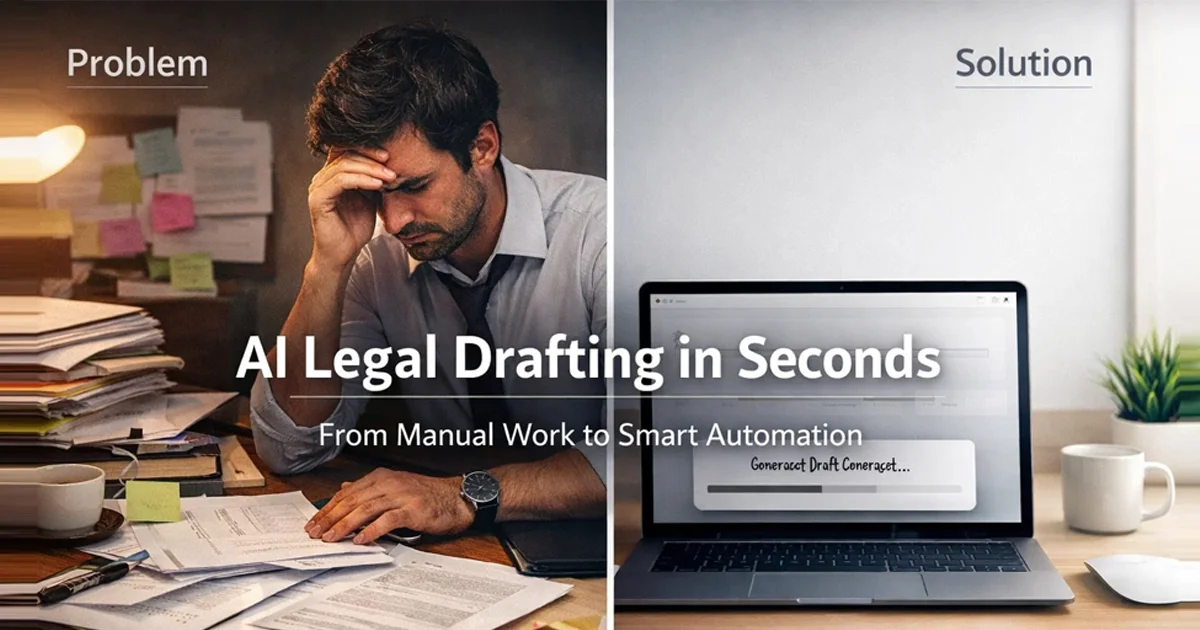
One of the most frustrating parts of legal writing is not always the final revision. It is the beginning. Starting from zero takes energy, especially when the lawyer already knows the core legal issue but still needs to build the document structure from the ground up.
That first stage often includes:
searching for an older file that is “close enough” to reuse,
copying clauses from previous documents,
rewriting introductions and definitions,
fixing layout and formatting before real drafting even begins.
With AI legal drafting, that process becomes faster and more intentional. A lawyer can prompt a system to create an initial structure for an NDA, a service agreement, a breach response, or a negotiation letter based on a specific scenario. Instead of wrestling with formatting and repetition, the lawyer gets a draft framework that can be reviewed, corrected, and strengthened.
This is especially helpful for solo lawyers who handle a mix of client work and administrative tasks in the same day. Saving even thirty minutes per matter can add up quickly across a week.
AI Legal Drafting for Contracts and Agreements
Contracts and agreements are among the most practical use cases for AI legal drafting. Many legal documents follow recognizable structural patterns, but every client situation still requires customization. That balance between repetition and specificity is where AI-assisted drafting becomes useful.
For example, a solo practitioner may need to prepare:
service agreements,
independent contractor agreements,
partnership terms,
confidentiality clauses,
basic business arrangement documents.
Using the Agreement Generator, lawyers can create a usable starting document faster, then refine definitions, obligations, dispute clauses, governing law language, and risk allocation according to the client’s actual needs.
That does not mean the first draft is ready to send. It means the lawyer is no longer forced to build the entire skeleton manually every single time. For busy practices, that workflow change is significant.
Faster Legal Research with AI Summarization
Drafting is only one part of legal work. Research is another major time sink, especially when the lawyer is handling complex issues with limited time. Reading long judgments, extracting facts, identifying holdings, and comparing authorities can take hours.
AI tools can help create a summarization layer over that process. Instead of immediately reading every page in full, the lawyer can use AI to generate a quick outline of the main issues, relevant reasoning, cited provisions, and practical takeaways. That allows faster triage.
This does not remove the need to read the primary source. But it can help answer an important early question: which cases deserve deeper attention first?
For solo practitioners, this efficiency matters. A lawyer who can quickly screen multiple authorities is in a better position to allocate time intelligently, especially when juggling drafting deadlines, hearings, and client communication in the same workflow.
Privacy-First Tools Matter More in Legal Work
One of the biggest concerns surrounding AI in legal practice is confidentiality. Lawyers are not simply drafting public blog posts or generic marketing content. They are often working with client facts, negotiation details, internal strategy, and commercially sensitive information.
That is why workflow choice matters just as much as drafting speed.
Browser-based tools are becoming more attractive because they reduce friction and can support a more privacy-conscious workflow. Tools that allow lawyers to create documents online without unnecessary account barriers are often easier to test, faster to access, and more aligned with a minimal-data workflow.
Even so, the rule remains the same: lawyers should think carefully before entering any confidential client information into any AI system. Smart use of AI starts with strong judgment, clean process, and a clear privacy mindset.
Clause Revision, Tone Adjustment, and Plain-English Translation
Legal drafting is not only about producing a document. It is also about improving the wording inside it. A clause may be legally acceptable, but still too vague, too aggressive, too weak, too dense, or too difficult for the client to understand.
This is another area where AI legal drafting becomes useful.
Lawyers can revise a paragraph and ask for a stronger version, a softer commercial version, or a clearer explanation in plain English. That can help when:
adjusting leverage in negotiations,
making documents easier for clients to understand,
comparing alternate clause styles,
cleaning up repetitive or unclear language.
For solo practitioners, that flexibility is valuable because client communication often requires switching between formal legal language and practical explanation. AI can support both, as long as the lawyer remains in full control of the final wording.
Best Practices for the AI-Augmented Lawyer
AI can accelerate legal workflows, but only if it is used with discipline. The safest and most effective approach is to treat it as an assistant, not an authority.
Always review line by line
No AI-generated legal document should be sent without full review. Clauses may be incomplete, wording may be overbroad, and citations or legal references may be inaccurate.
Verify the primary source
If AI summarizes a judgment, regulation, or legal article, always verify the actual source before relying on it in advice or advocacy.
Use structured tools where possible
When the goal is drafting, structured document tools are usually more useful than general chat alone. A dedicated workflow such as Create Document Online or the Agreement Generator can provide a cleaner starting point.
Protect confidential information
Do not assume every AI tool is appropriate for client-sensitive content. A fast workflow is only helpful if it remains professionally responsible.
Why Solo Practitioners Stand to Gain the Most
Large firms have long benefited from document systems, precedent libraries, and internal support teams. Solo practitioners usually do not have that luxury. They need tools that reduce effort without adding cost, complexity, or setup burden.
That is why AI legal drafting is particularly relevant to smaller practices. It helps solo lawyers move faster without lowering standards. It supports first-draft creation, improves document turnaround, and reduces the hours lost to repetitive formatting and clause assembly.
In a small practice, efficiency is not just convenience. It affects profitability, client responsiveness, and workload sustainability.
Conclusion
The future of legal drafting is not about replacing lawyers with machines. It is about reducing the clerical burden that keeps lawyers away from their highest-value work.
AI legal drafting gives solo practitioners a faster, more flexible way to create structured documents, review clause variations, and streamline routine drafting tasks. With the right process, lawyers can work more efficiently while keeping judgment, ethics, and final control exactly where they belong.
For practitioners looking to improve document workflow, tools like Create Document Online and the Agreement Generator offer a practical place to start.
The real advantage is not automation for its own sake. It is having more time for strategy, advocacy, and client service.